
Bob Flower’s Memories of Radcliffe
Part 17
CORONAVIRUS 7th REPORT 2021
I thought you might like to hear of some of the characteristics and characters of our village back in the day. Most of you will not be old enough to have known any of them but it will give you something of a flavour of years ago.
The first thing to realise is that the village population was so much smaller then. I would venture to say that, strange as it seems, everyone knew everyone in those days. There was no ASDA, Morrison’s, Tesco, Iceland, Aldi etc. so we all shopped in the village. ‘Going to town’ was once a week. Closing day was Thursday (afternoon) when all the retail shops in the county closed, (including Dolly Flower!)
Most local cricket clubs, including Radcliffe, had a ‘Thursday Eleven’ team that enabled lads in the retail trade, who normally worked on a Saturday, the opportunity to play.
We had a red (maroon) Trent (Motor Traction) single decker petrol bus, (No. 78), which came from Bingham every hour. Every bus had a conductor and a unique method of passenger signalling to the driver was fitted. A leather thong ran through holes in the roof frame which, when tugged, caused the clapper in a bell in the drivers cab to clang! Two tugs by the conductor gave him permission to drive off. The conductor selected different coloured tickets from a spring clipboard holding various values of fare. The ticket was punched with a hole for return or single. Golf Road, where I boarded, to Trent Bridge, (swimming at Portland Baths, the Meadows) child’s return, 4d (fourpence). The seats were hygienic, if a little uncomfortable, wooden slats.
Milk, non- pasteurised, straight from the cow was delivered from a churn in a horse drawn cart, later in a glass, one pint milk bottle. It was ladled from the churn with a long handled, half pint container and poured into the buyers jug. Half an inch of cream rose to the top, lovely! Bread was also delivered daily from a large ‘bread basket’ but from a van. Meat was delivered weekly also from a basket brought by a van. I would think the whole village was supplied from village shops. We had more or less everything. Miss Barratt, bakers shop and Post Office. Sid Huskinson and Clifford Parr, butchers, Mr (and Mrs) East, fishmonger, Harold Taylor (Alwyn Taylor’s father) haberdashery (everything from a darning needle to a woolly jumper!). Harold Crosby, hardware, everything from a tack to a 14 pound hammer or a pint of paraffin from the tank at the back! Both the Taylor and Crosby businesses were carried on when the sons returned from the war.
My Aunty Olive and her husband Fred Astill kept the tobacconist and sweet shop where the estate agents is now at the bottom of Walnut Grove. That shop was a wooden building then but was improved later with a brick outer skin. Son Hubert (Chick) and his wife Phyllis carried the business on when Olive retired.
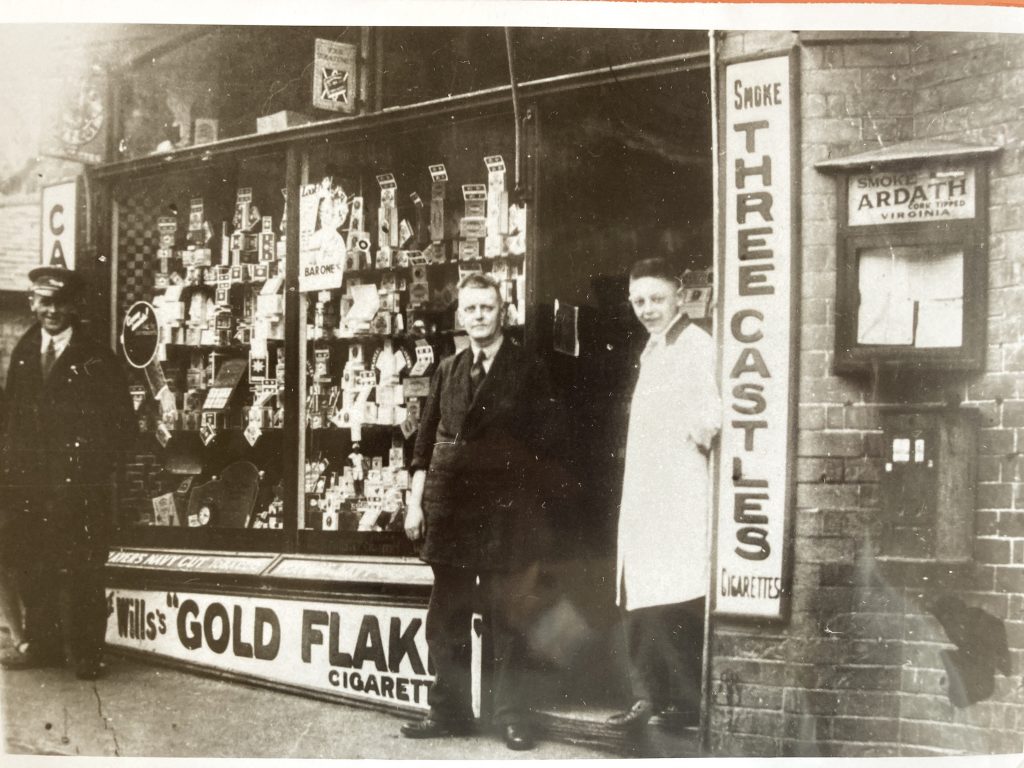 Before my time Fred was the village barber at the back of the shop up a side entry. His apprentice was Ron Starbuck who carried on the barbers business for many years after Fred died. I’ll tell you a fascinating story about Fred, who was a real character, in a future issue!
Village bikes were sold and repaired, and batteries charged, by Billy Redmile (of him later).
Donny Barratt was the village cobbler. His boot and shoe mending premises were at the back of the Chestnuts pub on West End Villas. At that time boots and shoes were leather and lasted years and were ‘soled and heeled’ frequently. Soles for quality footwear were stitched round the welts and metal ‘Segs’ nailed to the front and heels to make them wear longer. Studs were nailed to working boot soles (13 to each sole!) for the same reason. I’ve seen Donny with a mouth full of tacks, delivering them quickly, one at a time to fix a leather sole on to a boot…not with a hammer but with a smooth file to bang them in with one hit! Quicker than a hammer, I think! I can’t remember ladies footwear. There must have been high heels but, being only six, I didn’t have much interest!
Calladine’s bakery and shop, (opposite the Chestnuts, formerly Jack Lamberts farm yard) near to the chapel, had a fine selection of beers, wines and spirits. They also supplied fine specialised decorated cakes for birthdays, wedding etc. Sammy Tinkler’s chip shop on Knights Hill. Every night but Sunday cod and chips, one shilling and six pence 1/6d, (or seven and a half new pence), crispy bits of batter free! Drink the vinegar from a hole in the corner of the white paper bag.
The village youth club met in the basement, under the chapel, to play all the normal indoor games, table tennis, darts etc. Young ladies were welcome too!
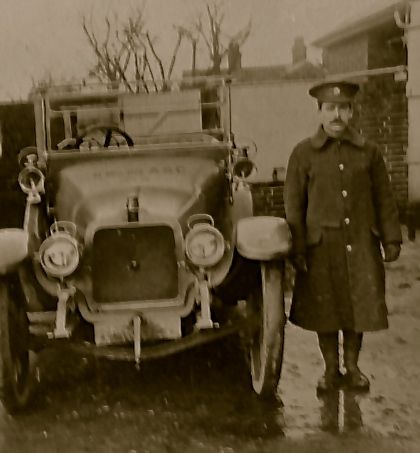 I will now give you a flavour of one or two village characters in the early 1940s – Billy Redmile, our village cycle repair expert. Billy served in the First World War after completing his apprenticeship at Sturmy Archer Gear company based at Raleigh, Nottingham. He was not very big and a little rotund! He wore wire rimmed glasses, a flat hat and a grey dust coat, he was a real character and what he didn’t know about bikes wasn’t worth knowing! His cycle workshop was on the right, next to the corner house at the bottom of Eastwood Road. Entry was gained through a large wooden door into a storage area containing spare bits and bobs for cycles. A large hanging canvas sheet separated this area from the workshop, which always smelled of paraffin and oil! An oily wooden bench ran along the length at the far end with a rack of shelves at the back. All manner of small cycle spares in various small glass jars were stored on the shelves. I particularly remember all the different sizes of ball bearings. Watching him build a bike wheel from a hub, a rim, a handful of spokes and inner tube and tyre and was fascinating. A little area adjacent to the workshop area was a recess containing two battered old armchairs, a pot stove, (glowing red in winter, with a kettle and heavily stained teapot and two mugs close by) A large coloured map of the world on the wall with little flags stuck in various locations. This was how Billy kept me up to date on what was happening, and where, in the war, I learnt more about the war and world geography in Billy’s workshop than ever I did at school! He also had a method of charging ‘accumulators’ as we called glass batteries for powering home wireless sets. We had two at home because one always went flat half way through Dick Barton, Special Agent or ITMA (Tommy Handley, It’s That Man Again!)
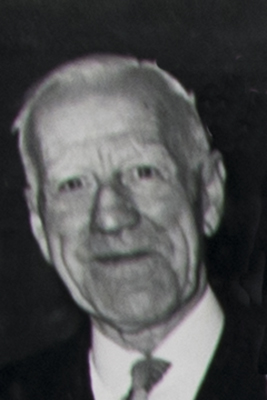 At Number 4 Eastwood Road lived Collett Chamberlain, joiner, undertaker, Special Constable and ARP warden! As well as directing funerals he made the coffin, usually from elm wood which it was considered (wrongly I think) fit for nothing else! Believe me making a coffin by hand is not easy and is a dying art (sorry). Remove the black top hat, replace it with a smart peak cap and you are a Special Constable (‘ello’, ‘ello’!) Replace with a tin hat with ‘W’ stencilled on it and you are an ARP (Air Raid Precaution) officer! ‘Put that light out’, was the cry for the slightest chink in the curtain. That’s what they call ‘multi tasking’ these days! We didn’t see many German bombers, but we were prepared and ready should they arrive! I sat for hours watching Collett make coffins, asking questions. He must have had the patience of Job! Knowing I was an amateur woodworker he would ask “have you had any luck with your mitres son”. (Cutting a 45 degree corner joint usually meant filler was needed for the amateur!).
The other village undertaker was Fred Beeson, father of Jason (who I worked for part time after I retired) now retired. His joinery workshop was at Thraves Yard now developed with new buildings.
My final character is George Wheatly. George was a joiner, wheelwright and amateur water colour artist. His workshop was on a cul-de-sac off Water Lane. Close to where the Snowdon family lived.
Making a wooden wheel for a cart or carriage calls for really special skills. So, you have a set of joinery tools, (non powered), a rack full of seasoned timber, mostly ash and oak, and round steel rims of different sizes made for you by the local blacksmith. How would you set about making the hub, the spokes, the rim and finally putting the red hot steel tyre then cooling with buckets of water. He again was a wonderful, patient character. He never showed any resentment to me sitting there continually asking questions. He was a craftsman in the truest sense of the word and sadly there are few of them left these days.